I'm a fourth-year physics PhD student at MIT. I am fortunate to be advised by Erin Kara and work closely with Kevin Burdge and Riccardo Arcodia.
I was an undergrad at Columbia, where I worked with Frits Paerels on X-ray astronomy and David Kipping on extrasolar planets, graduating in 2022. Before that, I grew up in Edison, New Jersey.
e-mail: joheen{at}mit.edu
Research Interests:
My research is in high-energy astrophysics, which provides a remarkable diversity of mysterious and beautiful phenomena to explore. I study compact objects (e.g. black holes, white dwarfs) using data primarily from X-ray telescopes (e.g. NICER, XMM-Newton) and ideas/models from plasma physics, atomic physics, general relativity, and radiative transfer. The overarching goal of this work is to understand how black holes and compact binaries form and evolve, interact with their surroundings, and produce electromagnetic and gravitational radiation to power some of the most energetic phenomena in nature. A mostly accidental theme of my current work is electromagnetic emission from low-frequency (~μHz-mHz) gravitational wave sources, and I am excited by their potential for multi-messenger astrophysics. Some topics I work on are:
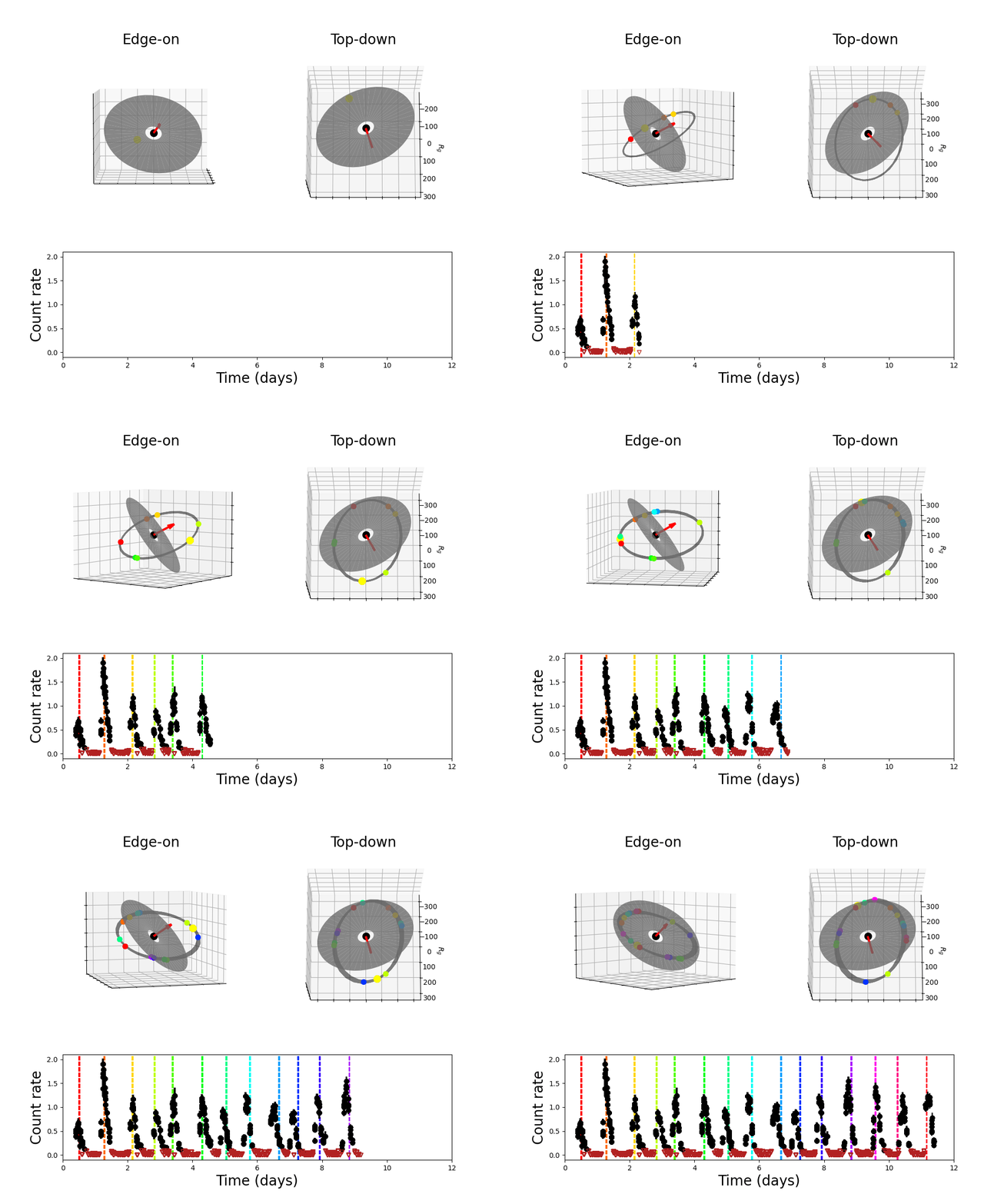
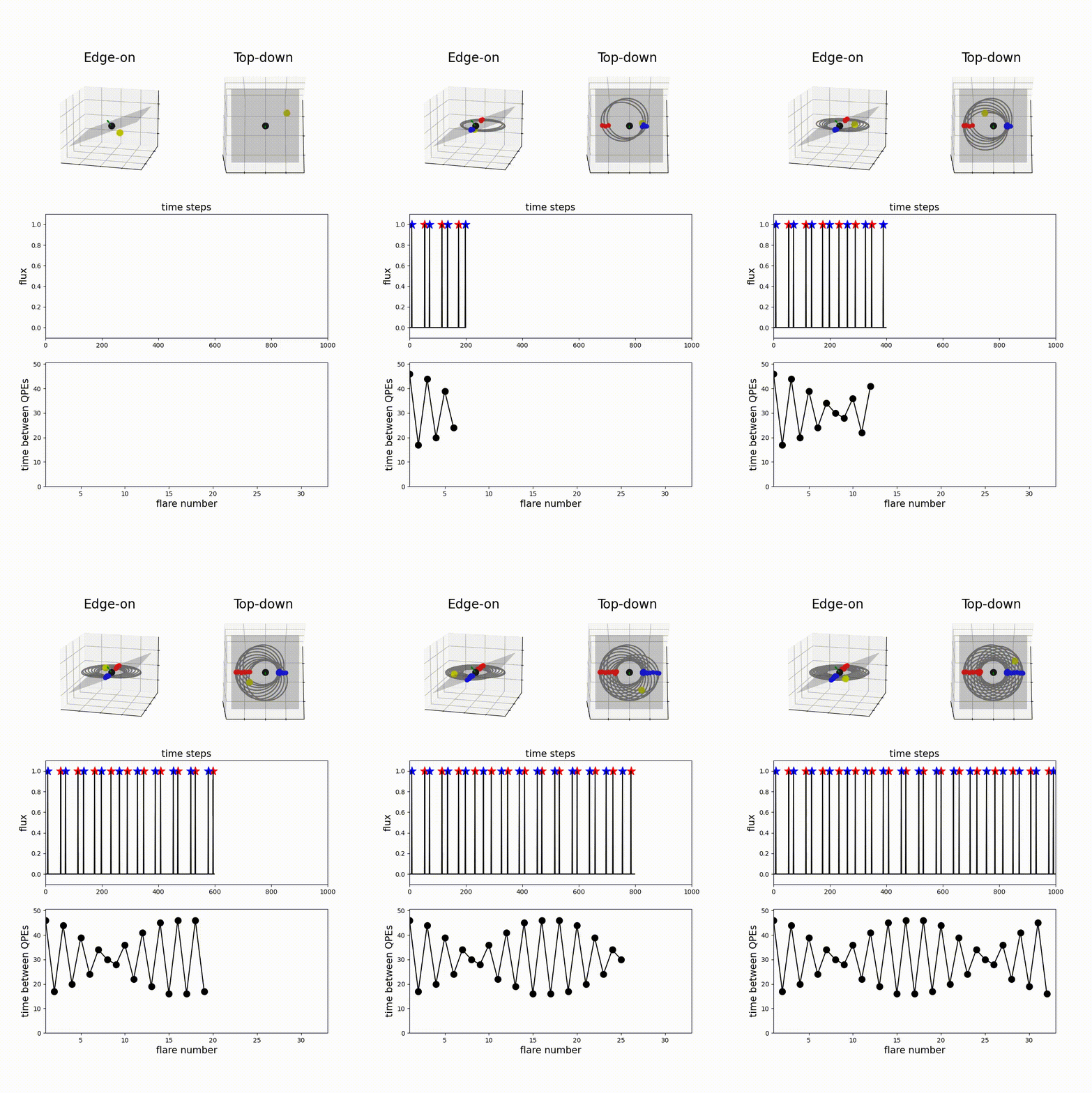
-Quasi-Periodic Eruptions (QPEs), a newly discovered type of recurring X-ray transient which may be the first-known electromagnetic counterparts to EMRIs. An enticing possibility is using QPE timings to map general relativistic precession effects within ~hundred gravitational radii of supermassive black holes (see e.g. the effects of frame-dragging and apsidal precession). My hope is that QPEs will enable new direct measurements of orbital dynamics in galaxy nuclei, and teach us something about black hole environments in the process.
-Ultracompact binaries, which are the dominant millihertz gravitational wave sources for upcoming space-based gravitational wave detectors. I study their orbital evolution as a probe of angular momentum transport during mass-transfer, and am curious what we may learn from multi-messenger study of their accretion disks.
-Tidal Disruption Events, which provide a unique laboratory to study turbulent black hole accretion flows where the initial conditions are approximately known.
More broadly, I am interested in exploring rich and varied datasets, high-performance computing, robust statistical inference, constructing toy models with hand-waving and order-of-magnitude physics, and trying to extract physical insights from observations even without the ability to perform controlled experiments. My personal reasons for studying astrophysics are the breadth of ideas I get to learn and use, and that I never fully grew up.Selected publications:
My first-/second-author papers are listed below, along with two-sentence summaries. You can find all of my papers on ADS, arXiv, or Google Scholar.
A positive period derivative in the quasi-periodic eruptions of ZTF19acnskyy
Joheen Chakraborty, Saul Rappaport, Riccardo Arcodia, Itai Linial, et al.
Accepted to Astrophysical Journal Letters
We made the first period derivative measurement in a QPE and found, surprisingly, that it is positive and large-magnitude (~0.01 d/d). We examined several physical toy models for the result and ruled out many of the simplest explanations, motivating further theoretical work.
[Paper]
X-ray spectral-timing properties of tidal disruption events
Joheen Chakraborty*, Megan Masterson*, Andrew Mummery, Erin Kara, et al. (*equal contribution)
Accepted to Astrophysical Journal
We studied the population-level variability properties of TDEs via Fourier timing, finding those which form coronae are more X-ray variable and show "redder" noise than pure-thermal sources, and thermal TDEs show Wien-tail variability enhancement making them excellent probes of SMBH accretion flow turbulence. We also find the X-ray spectral-timing properties of TDEs (even those with coronae) are fundamentally distinct from those of active galactic nuclei.
[Paper]
An eclipsing 8.56 minute orbital period mass-transferring binary
Emma Chickles, Joheen Chakraborty, Kevin Burdge, Vik Dhillon, et al.
Accepted to Astrophysical Journal
We discovered a short-period AM CVn-type binary and measured its period derivative. Using the arguments from our 2024 paper, we inferred the system properties to conclude it will be a high-SNR LISA source.
[Paper]
Prospects for EMRI/MBH parameter estimation using quasi-periodic eruption timings: short-timescale analysis
Joheen Chakraborty*, Lisa Drummond*, Matteo Bonetti, Alessia Franchini, et al. (*equal contribution)
Astrophysical Journal, Oct. 2025
We developed an open-source Bayesian inference code which models the effects of general relativistic orbital precessions on QPE timings within the EMRI model. We used it to assess how well, in principle, QPE timings may be used for physical parameter inference (of e.g. SMBH mass, spin, orbital properties...)
[Paper]
[Code]
Rapidly varying ionization features in a quasi-periodic eruption: a homologous expansion model for the spectroscopic evolution
Joheen Chakraborty, Peter Kosec, Erin Kara, Giovanni Miniutti, et al.
Astrophysical Journal, May 2025
We studied the unique time-evolving outflow in a QPE via X-ray spectroscopy, which provides the first direct constraints on the physical properties of the emission region. We constructed an analytical toy model for time-evolving radiation transfer in an expanding ionized atmosphere, achieving good qualitative agreement with the observations.
[Paper]
[Press]
[Highlight]
Discovery of extreme quasi-periodic eruptions in a newly accreting massive black hole
Lorena Hernández-García, Joheen Chakraborty, Paula Sánchez-Sáez, Claudio Ricci, et al.
Nature Astronomy, Apr. 2025
We discovered extremely bright, long-lived, long-period QPEs in a system which strains previous energetics arguments within the EMRI picture. They began years after an unusual optical nuclear transient, potentially indicating a new formation channel for QPEs.
[Paper]
[Press]
[Highlight]
Discovery of quasi-periodic eruptions in the tidal disruption event and extreme coronal line emitter AT2022upj: implications for the QPE/TDE fraction and a connection to ECLEs
Joheen Chakraborty, Erin Kara, Riccardo Arcodia, Johannes Buchner, et al.
Astrophysical Journal Letters, Apr. 2025
We discovered QPEs in an optically-selected TDE (the third such system). With the budding "population", we made a Bayesian argument to conclude that somewhere between 4-18% of optical TDEs show QPEs within five years.
[Paper]
[Highlight]
Expanding the ultracompacts: gravitational wave-driven mass transfer in the shortest-period binaries with accretion disks
Joheen Chakraborty, Kevin Burdge, Saul Rappaport, James Munday, et al.
Astrophysical Journal, Dec. 2024
We discovered three short-period AM CVn-type binaries, and measured the orbital period derivatives in two. We outlined some analytical arguments to place system constraints when the angular momentum loss required for mass-transfer is sourced by gravitational waves.
[Paper]
Testing EMRI models for quasi-periodic eruptions with 3.5 years of monitoring eRO-QPE1
Joheen Chakraborty, Riccardo Arcodia, Erin Kara, Giovanni Miniutti, et al.
Astrophysical Journal, Apr. 2024
We reported data from a long-term NICER/XMM QPE monitoring campaign, finding the burst energetics gradually decreased over a few years. We also found the first evidence for super-periodic modulations in the burst timings, potentially indicating orbital precession.
[Paper]
[Highlight]
[Talk]
Transit duration and timing variations from binary planets
Joheen Chakraborty, David Kipping
Astrophysical Journal, Feb. 2023
We used simple geometric arguments to compute analytical expressions for the phase-dependent variation in transit duration exhibited by binary planets (e.g. Pluto-Charon). We found they can be up to several hours, which should be observable.
[Paper]
Possible X-ray quasi-periodic eruptions in a tidal disruption event candidate
Joheen Chakraborty, Erin Kara, Megan Masterson, Margherita Giustini, Giovanni Miniutti, Richard Saxton
Astrophysical Journal Letters, Nov. 2021
We discovered the fifth known QPE via an algorithmic search of XMM archival data. Its most interesting feature was that it occured shortly after a TDE, a suggestive coincidence given the independent rarity of both; later work eventually confirmed this connection.
[Paper]
[Press]
[Talk]
Hundreds of new periodic signals detected in the first year of TESS with the weirddetector
Joheen Chakraborty, Adam Wheeler, David Kipping
Astrophysical Journal, Dec. 2020
We applied a phase-folding algorithm for signal detection in TESS data designed to be agnostic to the signal shape (only requiring periodicity). We found several previously unreported objects, most of which are probably eclipsing binaries.
[Paper]